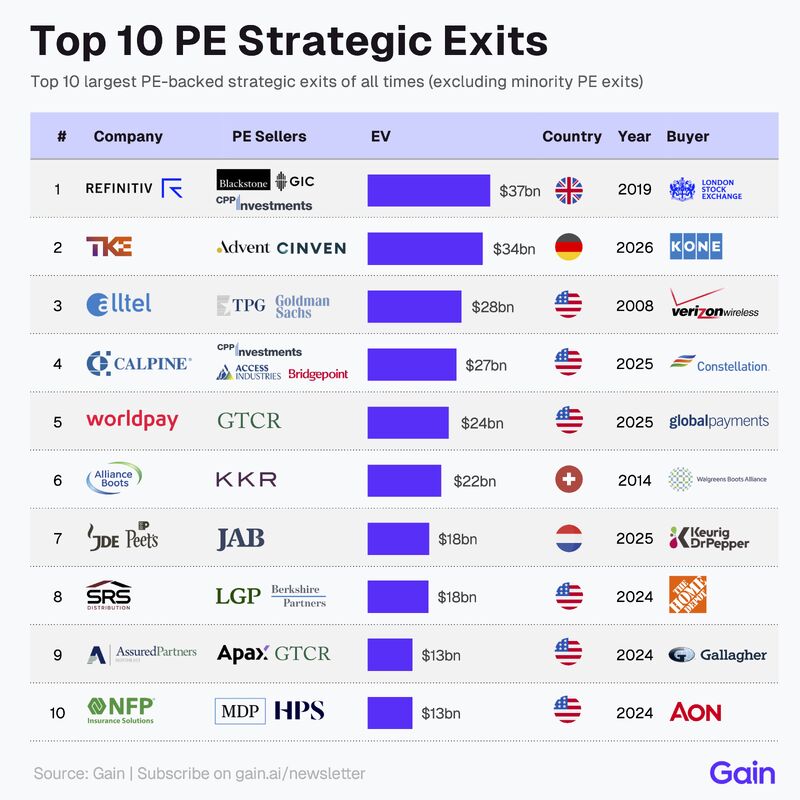
I am not entirely sure on which platform I saw it first, but I recently came across a ranking of the most profitable Private Equity exits to strategic buyers. In fifth place was Worldpay's sale to Global Payments for about $24bn in 2025. On that transaction, the sponsor GTCR roughly doubled its money in less than two years. I couldn’t immediately remember the first four on the list, but Worldpay struck me because it was the second time I had seen it near the top of a ranking for the most profitable PE transactions. The previous time was about 10 years ago, when Advent and Bain were selling blocks of shares after the Worldpay IPO in 2015.
The story of Worldpay is the story of how Private Equity recognized the value of an extremely powerful economic engine when banks themselves were too distressed to keep it. Over the 15 years after the global financial crisis, Worldpay was transformed from a neglected bank subsidiary into a standalone global payments platform. It was carved out, flipped, taken public, merged, acquired, carved out again, and sold again. Along the way, it generated billions in profits for a rotating cast of Private Equity sponsors.
The Structural Beauty of Payment Processing
The global financial system is built on a foundation of mundane infrastructure. Most consumers do not look beyond sleek plastic cards or one-click checkout buttons. But their payments rely on a complex system of authorization, clearing, and settlement that, for decades, was largely built inside banks or bank-adjacent networks. This infrastructure was viewed as a necessary utility: a cost center that facilitated the core business of lending money and holding deposits. Yet inside that utility was an economic engine, which, to this day, remains hidden to most people. They assume that a card transaction simply involves a consumer's bank on one end and a brand like Visa or Mastercard on the other. They assume the card issuers are the ones charging all the fees. In reality, in the middle of this value chain sits a third party called a merchant acquirer. That is Worldpay.
When a customer pays with a card, the total fee charged to the retailer is split in several directions. The first portion, called the interchange fee, goes to the card-issuing bank. A second portion, called a scheme or network fee and typically smaller, goes to card networks like Visa or Mastercard for providing the payment rails. In the EU and the UK, a regulated cap applies to interchange fees on consumer cards, not generally to scheme fees: broadly 0.2 percent for consumer debit cards and 0.3 percent for consumer credit cards. In the US, the Durbin framework (2010) caps debit interchange for large issuers using a cents-plus-basis-points formula ($0.21 + 0.05%). Interchange fee on credit cards is unregulated in the US. The final cut is the acquirer markup. The merchant acquirer connects the retailer to the card networks, manages authorization and settlement, and gets the funds into the merchant's bank account.
Merchant acquiring is a segmented industry. For small and medium-sized businesses, acquirers typically charge a simple blended rate, often a percentage fee plus a small fixed charge per transaction. The rate can be materially higher for very small, online, or higher-risk merchants (as high as 4% or 5%). For global enterprise merchants, acquirers use a model called "interchange++" or "interchange plus". In this model, the acquirer passes the interchange and scheme fees through to the merchant and adds a negotiated markup. For the largest multinational retailers, this markup is measured in basis points (as low as 10-15bps). In relative terms, large accounts are less profitable than smaller ones. But leading acquirers like Worldpay process tens of billions of transactions across the globe, so fractions of a percentage point compound into massive revenue streams.
Smaller merchants are charged more not just because they lack the leverage or knowledge to negotiate. Acquirers require a higher return because merchant acquiring is not entirely risk-free. Acquirers act as financial underwriters and take on credit and fraud risk. If a customer buys a product for future delivery, such as an airline ticket or a holiday package, and the merchant subsequently goes bankrupt, the customer can demand a refund through a chargeback. If the merchant is insolvent, the merchant acquirer is on the hook to cover the loss. A cluster of travel, ticketing, or high-risk merchant failures can turn what looked like processing revenue into credit exposure very quickly. In 1989, the bankruptcy of Braniff Airlines and Eastern Airlines nearly brought down National Data Corporation (NDC), the predecessor to today’s Global Payments.
This quick overview of the payment value chain helps explain what made the 2010s a golden era for companies like Worldpay.
- The industry was riding an unstoppable wave as consumers abandoned physical cash for digital payments and e-commerce.
- Just as importantly, during the decade after the global financial crisis, merchant default rates were exceptionally low, at least until Covid exposed how much risk sat in sectors such as travel.
Consequently, acquirers were able to rapidly scale transaction volumes and collect fees without suffering devastating credit losses.
Ironically, the banks that originally built these payment networks failed to hold them long enough to ride the wave. Within a massive global bank, merchant acquiring was a tiny fraction of total revenue. It competed for capital allocation against investment banking divisions, mortgage lending books, and trading floors. So when the financial crisis hit at the end of the 2000s, banks focused on what they considered their key assets, and merchant acquiring was rarely considered a crown jewel.
In 2008, the owner of Worldpay was Royal Bank of Scotland (RBS). Like most banks, RBS did not consider merchant acquiring a critical activity. Disposing of Worldpay would have been a rational decision in the context of the crisis. However, in that specific case, it did not happen through a voluntary strategic shift.
The Fall of the Royal Bank of Scotland
In the first decade of the 21st century, RBS had aggressively expanded through acquisitions to become one of the largest financial services groups in the world. This acquisition spree is how RBS gained control over Worldpay, which was part of Natwest, acquired by RBS in 2002. But the lack of discipline during this rapid expansion period meant that RBS found itself disastrously overexposed to the crisis. As liquidity dried up and counterparty trust evaporated, RBS was pushed to the brink of insolvency. So the British government stepped in. The government injected £45.5bn in recapitalization funds, alongside an eventually unused £8bn contingent recapitalization facility. RBS was effectively nationalized to keep the lights on and the cash machines functioning.
However, the UK was still part of the European Union at the time, and state aid within the EU comes with strict conditions. To prevent governments from unfairly subsidizing national champions and distorting the free market, the European Commission enforces competition rules. When a bank receives taxpayer money to survive, it is required to submit a restructuring plan and stick to it. Some level of creativity is allowed, but one of the first steps of these plans usually revolves around offloading assets to shrink the balance sheet and reduce the bank's overall market power. RBS was no exception. The bank separated its sprawling global empire into Core and Non-Core divisions. Worldpay was placed in Non-Core and put on the auction block.
Despite its Non-Core status, Worldpay was a highly profitable cash machine. It was Europe's largest provider of card payment services and one of the largest globally. Around the time of the sale, it processed nearly seven billion transactions a year, with a total volume of about £243bn. The forced sale of Worldpay presented a generational opportunity for Private Equity.
Even if you could identify the secular tailwinds for the sector in 2009, buying a heavily integrated division out of a distressed global bank was a difficult undertaking; enough to deter most buyers. But two Private Equity heavyweights, Advent International and Bain Capital, formed a consortium to bid for the asset. Both firms had deep experience in financial services and recognized the latent value trapped inside the bank's subsidiary. They understood that if they could extract the business, survive the operational separation, and modernize the technology, the operating leverage of the payments model could yield extraordinary returns.
In August 2010, an agreement was formally signed, and the deal closed in December. The consortium acquired Worldpay for an enterprise value of approximately £2bn ($3bn at the time), including contingent consideration. The bank retained a 19.99 percent minority equity stake. This stub equity allowed the bank to participate in future upside, softening the blow of the forced sale while preserving a link to a critical payments partner.
To fund the acquisition, Advent and Bain wrote a combined equity cheque of roughly £700m. The remainder was funded through a precedent-setting debt package. For years afterwards, lawyers still referred to "post-RBS Worldpay" terms when discussing intercreditor enforcement mechanics between subordinated and senior lenders.
Un-Mixing Paint
Financial engineering alone could not unlock Worldpay's value. The central challenge of the 2010 buyout was operational. For years, Worldpay had existed deep within the technological bowels of Royal Bank of Scotland. Its systems were tied to the bank's legacy mainframes, its data centers were shared, and its compliance and reporting software were intertwined with the parent company's broader infrastructure.
Anyone should be terrified at the idea of separating a high-volume payment processor from a global bank without dropping merchant transactions. You cannot simply flip a switch to turn off the bank and turn on the new company. A bank executive at Fifth Third Bank once compared this kind of IT separation to un-mixing paint. Every line of code, every network routing protocol, and every data storage architecture has to be audited, duplicated, tested, and cleanly severed.
Fortunately for Advent and Bain, there was a seasoned executive in charge of Worldpay at RBS. Ron Kalifa had been managing the division since 2002, and he was intimately familiar with both the massive potential of the business and the constraints imposed by the bank's legacy IT systems. Under new Private Equity ownership, Kalifa was given the capital and mandate to rebuild the company. The sponsors supported more than £1bn of investment to support growth, including approximately £400m on IT systems. The new architecture was designed to be scalable, secure, and capable of handling a massive expansion in global digital commerce.
The full implementation took years, but it paid off. Worldpay later said the modernized infrastructure increased processing capacity by up to 20 times. That capacity expansion represented pure operating leverage: Worldpay could onboard large multinational merchants without the same fear of system degradation or downtime, while the marginal cost of adding new volume was low. The Private Equity owners also looked externally for growth, investing roughly £300m in seven strategic acquisitions that broadened the product offering.
Between 2010 and 2015, the newly independent Worldpay created more than 2,500 jobs. It is fair to say this does not align with the stereotype of Private Equity firms slashing headcount and making portfolio companies as lean as possible. Advent and Bain used other tools to juice returns.
By 2013, three years into the investment, Worldpay was thriving. Its cash flows were predictable, operating leverage was expanding margins, and global debt markets were receptive to its profile. So Advent and Bain executed a dividend recap. Worldpay raised a new loan of about £700m. Approximately half of the amount was distributed to the Private Equity owners as a cash dividend. Advent and Bain therefore recovered a large portion of their initial £700m equity cheque. And returning that much cash early in the hold period all but guarantees an impressive IRR at exit.
Around the same time as the dividend recap, RBS decided to bow out completely. In November 2013, it agreed to sell its remaining 19.99 percent stake to Advent and Bain for approximately £250m, allowing the bank to book a respectable profit of about £160m on the final piece of Worldpay in its 2013 results. With this secondary purchase, the Private Equity consortium took full ownership of the business.
The Exit
Shortly after taking full control and issuing the dividend, the sponsors were tested by the market. Trade buyers and rival PE firms recognized the success of the turnaround. Ingenico reportedly submitted a £6.6bn bid, while Private Equity groups including Blackstone, CVC, and Hellman & Friedman or GIC circled the asset. Advent and Bain rejected the sale route and chose to prepare the company for a public listing.
Worldpay IPO'd on the London Stock Exchange in October 2015. For the six months ending in June 2015, just prior to the listing, Worldpay had posted net revenue of about £465.7m and adjusted EBITDA of about £182.6m. The market capitalization at IPO was set at £4.8bn, making it London's largest flotation of 2015. Institutional demand for the stock was strong.
For Advent and Bain, the IPO was a financial triumph. At the time of the listing, the two firms had earned a combined profit of about £3.2bn from their initial five-year investment. They monetized a portion of their holdings during the IPO itself, selling approximately 505m shares to the public and netting roughly £1.2bn in immediate cash proceeds.
As usual in these circumstances, the funds held on to most of their shares. Post-IPO, Advent and Bain retained a combined stake of just under 50 percent in the newly public company, valued at roughly £2.3bn.
They then staged their exit over the following 18 months. In April 2016, they sold a 13.8 percent stake via a block trade for about £740m. In September 2016, they executed another large block trade, selling about £987m of stock and reducing their combined holding to 10.7 percent. Finally, in February 2017, they sold their remaining shares, netting an additional £607m.
Advent's Global Private Equity VI fund recorded Worldpay as its single best-performing investment of that vintage. The fund achieved a gross multiple of 7.6x.
Just as surprising as the sponsors' return was the fact that Worldpay's public market history was short-lived.
The M&A Supercycle
After the high-profile IPO, the payment processing industry entered an M&A supercycle. Scale had become one of the only metrics that truly mattered. The larger the processor, the lower the marginal cost per transaction. With lower marginal costs, a company could price aggressively to win the business of the world's largest multinational e-commerce merchants.
In July 2017, news broke that a US-based payments rival named Vantiv had approached Worldpay regarding a merger. Vantiv itself was a successful Private Equity carve-out executed by one of the same sponsors. In 2009, Advent International had acquired a majority interest in Fifth Third Bank's payment processing business, which was later renamed Vantiv and listed in 2012. Shortly before acquiring Worldpay in Europe, Advent had run a similar playbook in the United States. It separated the asset, modernized the systems, and took the company public.
By August 2017, the transatlantic deal was sealed. Vantiv agreed to acquire Worldpay in a transaction implying an enterprise value for the British company of approximately £9.3bn, or about $12bn. The combination created a payments group with a pro forma enterprise value of approximately £22.2bn, or $28.8bn. The transaction rationale was that Vantiv was strong in US acquiring, while Worldpay was strong in the UK and Europe. There was limited geographical overlap, so the combined entity could offer global e-commerce merchants a single payment gateway capable of processing transactions across both continents. Vantiv assumed the Worldpay name for the combined corporate entity and listed the new group on the New York Stock Exchange.
The consolidated Worldpay Inc. promised to generate substantial synergies for public shareholders. These savings, expected to be around $200m annually on a pre-tax basis, would primarily come from eliminating redundant corporate functions and migrating operations onto unified technology platforms. On a pro forma basis, the combined entity had adjusted EBITDA of around $1.5bn, a margin close to 48 percent, and free cash flow generation exceeding $1bn.
But the M&A supercycle in fintech was not over. Fidelity National Information Services, better known as FIS, decided it needed to own a merchant acquiring business. In 2019, FIS launched a spectacular bid and acquired Worldpay for about $43bn, including the assumption of debt.
FIS's rationale was vertical integration. In the payment ecosystem, software providers are typically divided into two sides:
- The issuer side serves the banks that issue cards.
- The merchant side serves the retailers that accept cards.
Historically, these businesses were kept separate. The strategic idea behind the 2019 merger was that FIS could sell core banking and ledger software to financial institutions on the issuer side while simultaneously processing payments for retailers on the merchant side. By controlling both ends of the transaction lifecycle, FIS hoped to capture more data, reduce friction, and build a broader financial technology ecosystem. Merchant acquiring went from a peripheral activity inside FIS to a major reportable segment representing roughly a third of the enlarged company's revenue base.
Unfortunately, this acquisition became a textbook example of a corporate strategy that only looks brilliant in a spreadsheet. The grand vision of combining slow-moving banking software with fast-moving merchant acquiring failed to materialize the way FIS management had promised Wall Street. The core issue was a deep cultural and operational divergence. Providing highly regulated ledger software to legacy banks requires a completely different sales motion, risk appetite, and technological cadence than providing API-driven checkout gateways to digital merchants.
The public market clearly indicated that it was unimpressed by the conglomerate. In the years after the acquisition, FIS shares badly underperformed the broader market (-53% vs. +45% for the S&P500 between May 2019 and May 2023). The acquisition destroyed, rather than created, value. As this unfolded, tech-native competitors such as Stripe and Adyen continued to pressure the e-commerce side of the market.
Returning to Private Equity
Under pressure from activist investors and frustrated shareholders, FIS had to admit defeat. In early 2023, it first announced a plan to separate Worldpay. A few months later, it changed course and agreed to sell a 55 percent majority stake in Worldpay to Chicago-based Private Equity firm GTCR. The deal valued Worldpay at $18.5bn, including $1bn of contingent consideration. Yes, less than half of the $43bn enterprise value FIS had paid just four years earlier. The transaction represented the largest deal in GTCR's history, with the sponsor committing a massive equity cheque and additional capital for follow-on growth.
Worldpay was once again a Private Equity portfolio company and was expected to move quickly, as PE-owned businesses do. In this case, everything went fast even by Private Equity standards. In April 2025, a three-way transaction between Global Payments, FIS, and GTCR was announced.
Both Global Payments and FIS had previously tried to operate dual business models, serving both merchants and card-issuing banks. Both had watched their share prices languish as the market penalized them for lack of focus. The 2025 mega-deal was a coordinated agreement to swap assets so each company could refocus. Global Payments agreed to acquire Worldpay in its entirety, allowing it to focus on merchant solutions. At the same time, Global Payments agreed to sell its own Issuer Solutions business to FIS, allowing FIS to double down on banking and issuer services.
Global Payments agreed to acquire Worldpay from GTCR and FIS for a net purchase price of $22.7bn. The total transaction value reached $24.25bn when accounting for $1.55bn of anticipated tax assets. At that price, Global Payments said it was acquiring Worldpay at an 8.5x adjusted EBITDA multiple on a net basis inclusive of run-rate synergies. Worldpay brought scale: on a combined basis, the company enabled approximately 94 billion transactions and $3.7 trillion in volume across more than 175 countries.
Global Payments sold its Issuer Solutions business to FIS for $13.5bn, representing a 12.3x adjusted EBITDA multiple for that asset. FIS expected $125m in opex synergies within 3 years. FIS paid using a combination of cash and the value of its existing 45% stake in Worldpay.
| Worldpay EV to FIS net value reconciliation | Value ($bn) |
|---|---|
| Worldpay enterprise value | $24.25 |
| Less: net debt and debt-like items | ($7.2) |
| Equity value | $17.0 |
| Less: transaction fees and other costs | ($0.6) |
| Distribution value | $16.4 |
| FIS share (45%) | $7.4 |
| Less: change-of-control premium paid to GTCR | ($0.8) |
| Pre-tax value to FIS | $6.6 |
| Less: total taxes | ($0.9) |
| Net value to FIS | $5.7 |
The true winner of the 2025 transaction was GTCR. By selling its 55 percent stake in Worldpay to Global Payments, it roughly doubled its initial equity investment in less than two years.
GTCR received 59% of its consideration in cash for an amount around $6bn. Global Payments used cash proceeds from selling its Issuer Solutions business to FIS, cash on its balance sheet, and new debt to fund the acquisition and refinance Worldpay's debt. For the remaining 41%, GTCR received approximately 43m Global Payments shares at an issue price of $97.00 per share. That stock consideration gave the Private Equity firm roughly 15 percent ownership in the enlarged Global Payments. Flipping an asset like this in less than two years was a masterclass, delivered at a time when Private Equity was starved for exits. The $800m change-of-control payment extracted from FIS was the icing on the cake.
No doubt GTCR's LPs were delighted. But not everyone cheered. On the day the deal was announced in April 2025, shares of Global Payments fell sharply (-15%), closing at about $71.45. Investors were skeptical of the execution risks of Worldpay's integration. This reduced the implied value of GTCR’s total payout from the initial headline figure to roughly $10 billion. The market did cheer FIS's decision to exit the messy merchant business and return to its more predictable banking roots. FIS stock jumped (+9%) on the news.
Worldpay's Legacy
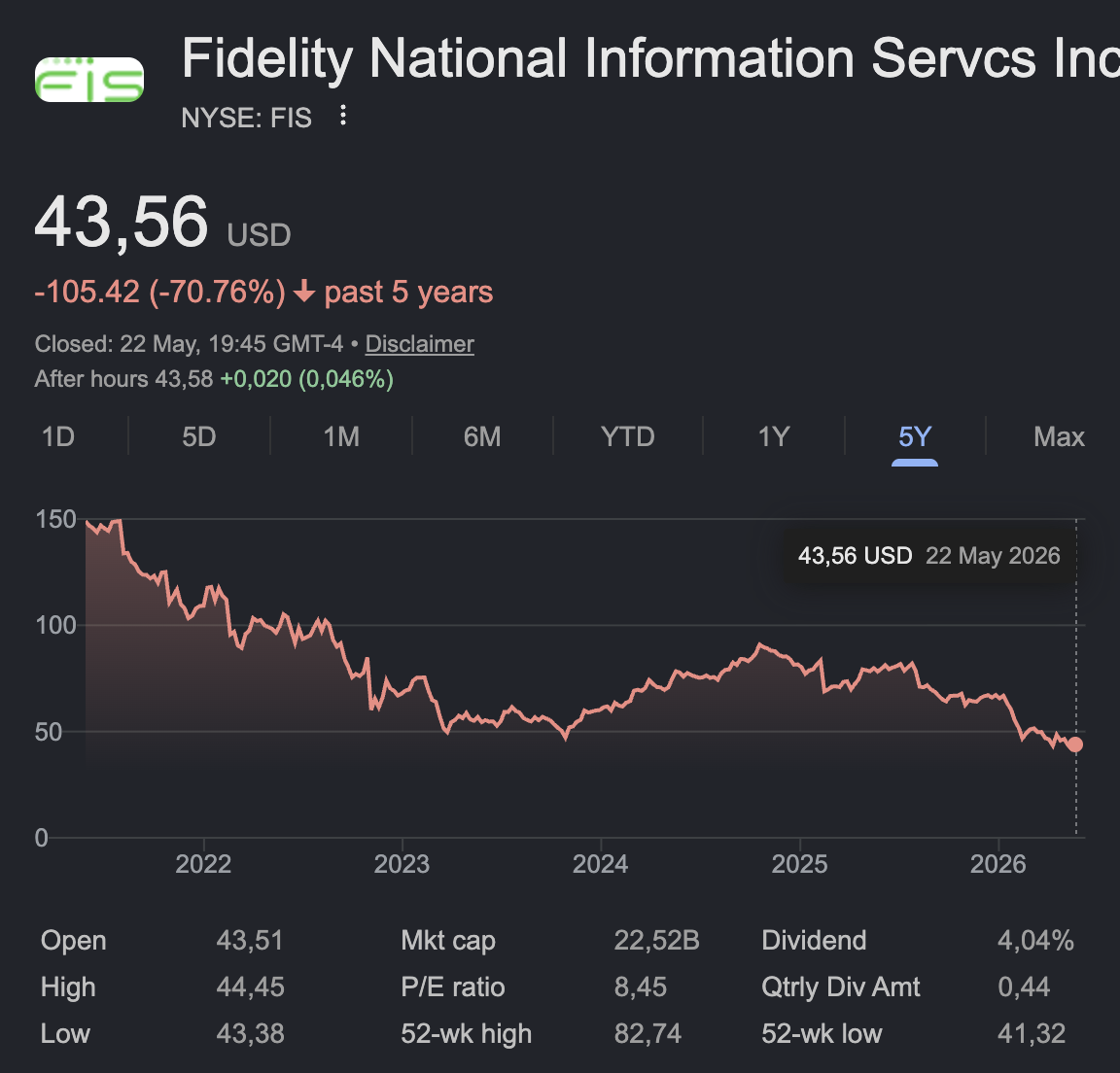
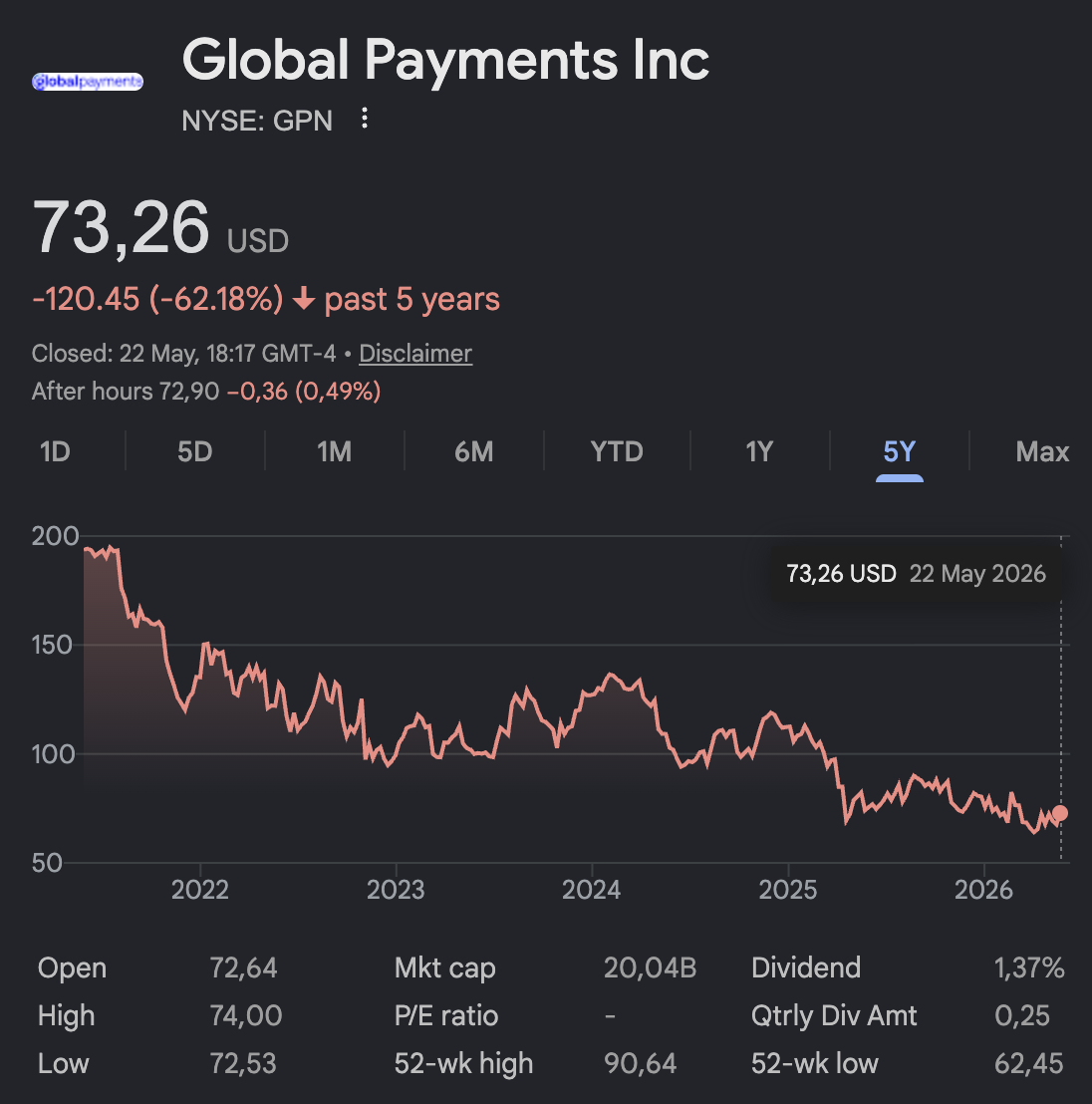
As of May 22, 2026, a little over a year after the transaction was announced and just over four months after it closed, Global Payments' stock was trading at $73.26, still roughly around its post-announcement level. FIS was trading at $43.56, far below the short-lived pop it enjoyed on announcement day. Over the last five years, FIS has fallen from around $150 to the low-$40s. Global Payments' share price has also lost about two-thirds of its value over that period, but it can’t be blamed on Worldpay. Unlike FIS, Global Payments has not obliterated tens of billions of dollars on a failed merger. Or at least not yet. Four months after closing is too soon to draw conclusions about the long-term legacy from Global Payments' perspective.
It is not too soon, however, to comment on Worldpay's long-term legacy for Private Equity. In the course of 15 years, it was twice the target of PE sponsors. In both cases, it resulted in a landmark transaction generating billions of dollars of upside. What is interesting about these LBOs is that they were not the typical Private Equity play of the ZIRP era: buying a boring cash-generating business, maximizing leverage, streamlining operations and overheads, benefiting from EV multiple expansion across the market, and exiting to another PE player.
The Advent-Bain LBO was about carving out an unloved asset from a struggling bank. Regulations around bailouts, especially in Europe, and the dogmatic approach of liquidating assets inside bad banks, mean that these opportunities arise from time to time. But that does not make un-mixing the paint simple. Advent and Bain invested massively in the business and took a gamble by refusing to sell to another buyer in 2015, choosing instead to IPO the business.
In GTCR's case, value was extracted through trading skill. As with Advent and Bain, it started by offering to take an asset off someone's hands to solve a problem. GTCR's genius was convincing someone else to take the asset off its own hands, getting repaid very quickly while earning 15 percent of the buyer's equity and collecting an $800m change-of-control fee in the process.
I personally think Worldpay will remain a dominant merchant acquirer in the long term, but who knows? What I am certain about is that, if Private Equity history books existed, there would be a chapter dedicated to Worldpay.