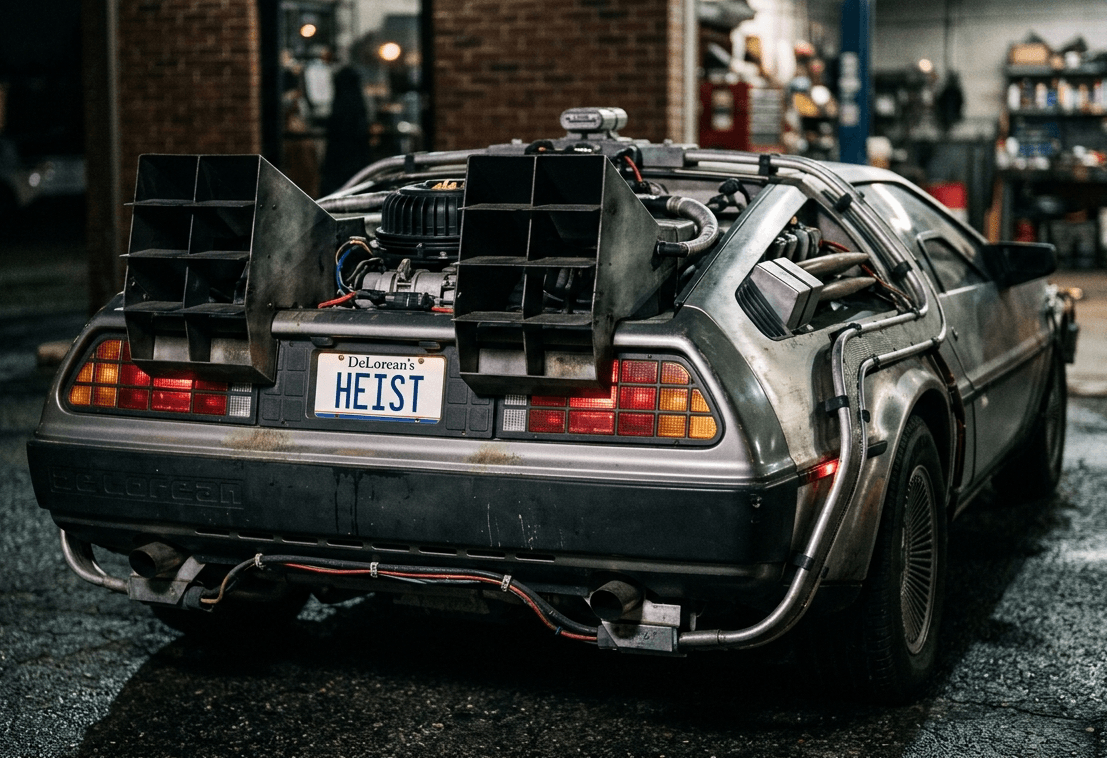
For most people, “DeLorean” is associated with the legendary time machine from Back to the Future (1985). And if you are under 50, you probably don’t know that a politically humiliating financial heist hides beneath the gull-wing doors and brushed stainless-steel exterior of the DMC-12 car.
“DeLorean” isn't a fabricated brand name from a marketing firm. It’s the surname of John Zachary DeLorean, an unusual automotive executive who stood six-foot-four, who had a surgically enhanced jawline and sported the swagger of a movie star. Hollywood made his car famous for generations, but his actual life story is a movie plot in its own right.
The Corporate Renegade
Born to a working-class family in 1925, John followed a natural path for a smart kid from Detroit: automotive engineering. He rose rapidly through the ranks of the Packard Motor Car Company before moving to General Motors in 1956. At GM, DeLorean became a legend. Credited as the mastermind behind the Pontiac GTO, he effectively launched the highly lucrative American muscle car era. By 1965, at age 40, he became the youngest division head in GM's history, running Pontiac and later Chevrolet.
However, DeLorean was a flamboyant figure who increasingly clashed with Detroit's conservative corporate culture. Driven by a desire for personal glory, he left GM in 1973 and established the DeLorean Motor Company (DMC). He positioned himself as a maverick visionary, ready to disrupt the global automotive industry with an "ethical" and futuristic sports car.
For years, DeLorean shopped his project globally but failed to secure financing and factory sites in Detroit, Texas, Puerto Rico, and the Republic of Ireland. Then, in 1978, the planets aligned: the UK government was looking to heavily subsidize anyone willing to set up shop in Northern Ireland.
One Man's Troubles Are Another's Opportunity
In the late 1970s, Northern Ireland was locked in the violent grip of "The Troubles", a period of severe political and sectarian unrest. In Belfast, where local unemployment hovered at 80 percent, economic despair was fueling paramilitary recruitment for groups like the Irish Republican Army (IRA). The British government was desperate for a high-profile win, specifically a massive job-creation project that would signal stability.
When DeLorean showed up, the British government was terrified of missing out and opened its vault. In Summer 1978, an unprecedented financial package allowed DeLorean to establish the manufacturing plant for DeLorean Motor Cars Limited (DMCL) in Dunmurry, a suburb of Belfast. Renault was contracted to build the factory.
The Northern Ireland Development Agency (NIDA) even offered to fund R&D through a loan up £7.92 million but DeLorean ultimatily used an American entity to pool capital. In September 1978, the DeLorean Research Limited Partnership (DRLP) was established as a tax-advantaged vehicle, raising $12.5 million from a syndicate of high-profile investors. The roster included prominent figures like entertainer Sammy Davis Jr., late-night host Johnny Carson, novelist Ira Levin, and the chairman of Wendy's. DRLP’s capital was officially earmarked for R&D, while DMCL was supposed to build the cars.
Between July 1978 and February 1982, the British government injected approximately £77 million into the DMCL project. DeLorean managed to secure these vast sums with minimal personal financial exposure. The overarching goal of this sovereign venture capital was to produce 30,000 sports cars annually and create a permanent workforce of 2,000 within five years. Because the government couldn't afford the political nightmare of the factory failing in a war zone, DeLorean knew he could keep the money flowing, no matter what. And he did. The sovereign funding acted as a classic "soft budget constraint” - a euphemism for a blank check.
Had the Dunmurry plant actually spit out 30,000 DMC-12s a year, we’d occasionally see them on the roads today. But we don’t. So, what happened? Funding clearly wasn’t the issue.
The Failing Car
There was one massive problem: no number of employees would have been enough for DeLorean in 1978; his car just couldn't be built.
The original prototype for the DMC-12 was based on Elastic Reservoir Moulding (ERM). DeLorean had acquired the licensing rights for this novel manufacturing process, which promised to use plastic-sandwiched foam panels to provide high structural strength at a very low weight.
However, as the project moved toward the pre-production phase, it became clear that ERM technology was fundamentally unworkable for mass automotive production. The plastic chassis prototype, to which front and rear subframes were bolted, was unstable, and the vehicle lacked the structural integrity required for safety and performance.
Furthermore, a late decision to swap a planned Citroën four-cylinder engine for a heavier Renault V-6 meant pushing the engine to the rear, completely ruining the car's weight distribution.
DeLorean found himself with millions in government funding, a half-built factory in Belfast, and a car that couldn't be manufactured. He desperately needed a proven automotive engineering firm to redesign the vehicle from the ground up, and he needed them to do it in an impossibly short timeframe.
So, DeLorean turned to an engineering god who was perpetually strapped for cash.
The Broke Engineering Genius
Anthony Colin Bruce Chapman was a venerated English design engineer and the founder of Lotus. His engineering philosophy, famously summarized as "simplify, then add lightness", revolutionized motorsport.
Chapman pioneered innovations like stressed-member engine blocks, monocoque chassis, and aerodynamic downforce. Between 1962 and 1978, Team Lotus won seven Formula One Constructors' titles, six Drivers' Championships, and the Indianapolis 500. Yet, despite his unparalleled track record, the financial stability of Group Lotus was perpetually precarious. F1 racing was incredibly capital-intensive, and the production side of Lotus Cars struggled through the economic downturns of the 1970s.
DeLorean needed Chapman to redesign the DMC-12 from scratch. Chapman needed DeLorean’s massive government funding. It wasn’t exactly a match made in heaven, but they had their own version of Cupid: a man named Jaroslav "Jerry" Juhan, based in Switzerland.
Juhan was a Czech-born former Porsche race-team driver who had successfully introduced Porsche to the South American market. More importantly, he had transitioned into a knowledgeable intermediary within the highly secretive world of Swiss banking. His wife, Marie-Denise, operated as a car importer and a dealer in precious stones. Together, the Juhans possessed significant wealth and had established financial connections to Colin Chapman, allegedly helping keep Lotus afloat during lean periods.
Opaque Structuring
In October 1978, Chapman and DeLorean met in Geneva. There, they agreed to channel the engineering payments through a third-party firm named GPD Services Incorporated. GPD stood for Grand Prix Drivers (or General Product Development Services in some documentation) and was registered in Panama. Incorporating in Panama ensured absolute corporate secrecy, shielding the firm's true beneficiaries from regulatory scrutiny.
The financial architect of the operation was Fred Bushell, the long-serving finance director of Group Lotus, known internally as "Uncle Fred". He was the man tasked with the creative accounting necessary to keep Chapman’s racing and manufacturing empire afloat and free from creditors. Juhan facilitated the Swiss-bank arrangements, ensuring the funds could be received and distributed outside the purview of British and American tax authorities.
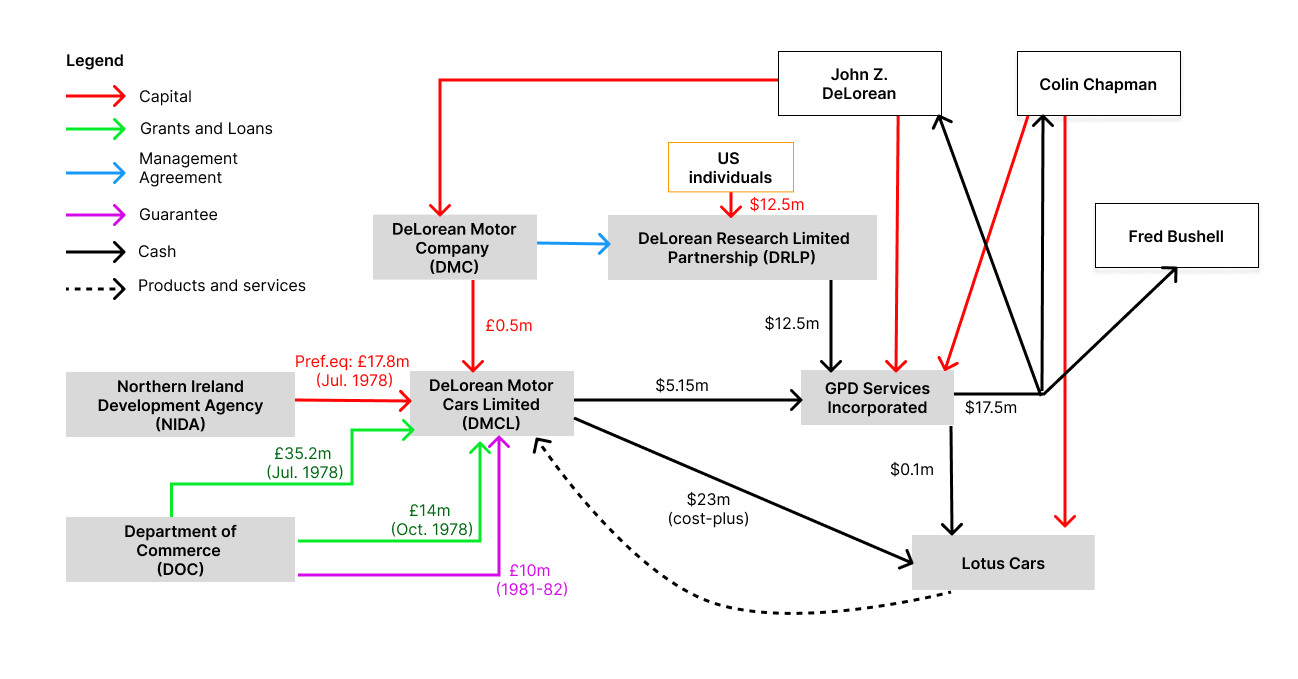
On November 1, 1978, John DeLorean executed a formal contract on behalf of DMCL and DRLP with GPD Services Inc. Under this contract, GPD was officially retained to perform the engineering work on the DMC-12 for payments totaling $5.15 million from DMCL and $12.5 million from DRLP. The contract explicitly noted that GPD had retained Lotus Cars Limited "to assist" in the project.
In reality, Lotus was doing 100 percent of the engineering work. GPD was a phantom corporation with no patents, no infrastructure, no engineering staff, and no operating history. Its "headquarters" was Marie-Denise Juhan's Geneva apartment. The excuse given to investors and auditors was that GPD was acting as an intermediary to protect Lotus from specific international tax liabilities and potential product liability exposure in the US.
Cost-Plus
Pursuant to the contract, the DeLorean entities transferred $17.65 million (roughly £8.83 million at the time) to GPD between late 1978 and early 1979. And the paper company did a great job... on paper.
Lotus completely overhauled the DMC-12, scrapping the ERM chassis design and replacing it with a backbone-type unit very similar to the one used in the Lotus Esprit. A fiberglass body was mounted onto this chassis, which was then clad in the famous stainless steel panels. Production started in December 1980 and, by early 1981, the DMC-12 was finally rolling off the assembly line in Belfast.
The only issue with this perfect execution was that none of it was financed by GPD. Forensic accounting later revealed that, of the $17.65 million sent to the Panamanian shell company, only $137,167 actually reached Lotus. The engineers in England couldn't build a chassis with money sitting in secret Swiss accounts. So how did they do it?
They simply asked the UK for more taxpayer money. DeLorean and Chapman operated under the assumption that financial oversight would be lenient, knowing government officials were deeply incentivized to report the project as a success. They set up a secondary "cost-plus" contract directly between DMCL and Lotus. A cost-plus contract is essentially an open-ended tab where the client covers all expenses, plus a guaranteed profit.
Against this backdrop, Lotus billed DMCL for every hour of engineering, every test chassis, and every fabricated component. In the end, Lotus billed the British taxpayer an additional $23 million (£11.5m) to do the exact same work the initial $17.65 million was meant to cover.
Recession and Politics
During the first year of production, up until the end of 1981, about 7,500 cars were produced. With a price tag of $25,000 (equivalent to $89,000 today), the DMC-12 was positioned as a luxury product targeting the US market. However, its release coincided with a major economic recession in the US, which crippled the new car market. Fewer than 3,000 cars were sold.
Pinning the DMC-12’s struggles entirely on macroeconomic conditions is an oversimplification. Competing models with lower price tags and more powerful engines (like the Chevrolet Corvette) sold in record numbers during 1980–81 despite the recession. Regardless of the reason, the company was miles away from its break-even point (estimated between 10,000 and 12,000 units).
DeLorean returned to the British government for another massive bailout to keep the factory operational. But the political landscape in London had shifted: Margaret Thatcher’s Conservative government had replaced the Labour administration. Thatcher was ideologically hostile to state subsidies for private enterprise, and the "soft budget constraint" suddenly hardened. Funding was frozen. On February 19, 1982 - just 12 months after full-scale production began - the British government placed DMCL into receivership, appointing liquidators from the firm Cork Gully to salvage what remained of the taxpayers' investment.
At this point, DeLorean still believed he could save his company by buying it out of receivership. He needed approximately $17 million to do so and began seeking alternative funding. We’ll never know if his primary motivation was to keep the GPD fraud hidden or simply to save face, but he certainly got creative in his search for capital.
The FBI Sting Operation
In mid-1982, DeLorean was approached by James Hoffman, a man claiming to have a lucrative business opportunity. Hoffman offered to connect DeLorean with "investors" who could provide $15 million in immediate capital through a complex scheme involving the importation and distribution of narcotics. Unbeknownst to DeLorean, Hoffman was a convicted drug smuggler who had struck a deal with federal authorities to act as a confidential informant in exchange for leniency.
On October 19, 1982, after undercover FBI agents videotaped the sting operation at a Los Angeles hotel, John Z. DeLorean was arrested and charged with attempting to traffic $24 million worth of cocaine.
The arrest triggered the total collapse of his house of cards. The manufacturing plant was closed, and liquidation proceedings were initiated immediately. As bankruptcy liquidators swarmed the wreckage of the company, they quickly discovered the $17.5 million GPD black hole.
So, What Happened to the $17.5M?
The funds didn't sit idle in the Panamanian corporate registry; they were quickly integrated into the global financial system, shielded by banking secrecy laws. During subsequent legal actions, prosecutors alleged that the funds paid to GPD were transferred to Swiss accounts controlled by the Dutch bank Pierson, Heldring & Pierson N.V. in Amsterdam and Zurich. From these secure accounts, the spoils were divided. Former DeLorean Motor Cars executive Nick Sutton, in his retrospective analysis of the company, claimed the $17.5 million was split primarily between Colin Chapman and John DeLorean, with the "loose change" given to Fred Bushell for facilitating the accounting mechanics.
DeLorean utilized his share of the embezzled funds to expand his personal corporate portfolio in the US. $8.9 million of the laundered proceeds went to repay a massive debt to Continental Illinois Bank, which he had incurred to purchase a Utah-based manufacturer of snow-grooming equipment called Logan Manufacturing.
Meanwhile, Chapman’s share disappeared into his own web of offshore trusts and accounts. These funds bolstered his personal wealth and provided resources for his cash-strapped racing empire.
Secrets Taken to the Grave
Shortly after liquidation proceedings began, the receivers held one brief conversation with Colin Chapman regarding the missing funds. The discussion was inconclusive, but sensing the net was rapidly closing, Chapman flew to Paris in December 1982 to meet with Jaroslav Juhan.
He returned to the Lotus factory airstrip in Norfolk, England, on December 15, 1982. The very next day, he suffered a fatal heart attack at the age of 54. As the GPD scandal broke, conspiracy theories ran wild in the tabloid press and the automotive community, suggesting Chapman had faked his own death and fled to South America.
DeLorean's Escape
DeLorean’s most pressing issue was the drug charges. He was ultimately acquitted in August 1984 after his legal team successfully argued government entrapment.
He then faced a federal grand jury indictment in Detroit in September 1985. The US government charged him with 15 counts of fraud, racketeering, and tax evasion specifically related to the diversion of the GPD funds into his personal Citibank accounts and the subsequent purchase of Logan Manufacturing.
In December 1986 - almost exactly four years after Chapman's death - DeLorean's legal team successfully dismantled the prosecution's narrative. The Detroit jury found DeLorean not guilty on all 15 counts.
The British government maintained outstanding warrants for his arrest for conspiracy to defraud, but the US declined to extradite him. DeLorean lived the rest of his life as a free man, untethered from the financial destruction he had orchestrated. He passed away in 2005 at the age of 80.
The Smallest Fish in the Pond
Not all conspirators managed to evade British justice. In June 1989, British police arrested “Uncle Fred”. The case moved slowly, and Bushell’s trial finally took place at the Belfast Crown Court in 1992. Faced with overwhelming documentary evidence, Bushell pleaded guilty to his role in the GPD affair.
He was convicted, sentenced to three years in prison, and slapped with a £2.25-million fine, with total financial penalties and cost recoveries amounting to roughly £4.5 million. During sentencing, the Judge explicitly noted that, had Colin Chapman and John DeLorean been standing in the dock alongside Bushell, the gravity of their crimes would have warranted "at least 10 years" imprisonment.
Assigning Blame, Recovering Assets
Classified UK Cabinet minutes, released by a US court in 1996, revealed that government ministers had deliberately ignored significant risk factors and warnings from civil servants in order to secure the promise of employment in Northern Ireland. When financial irregularities began to surface, the institutional instinct was to protect the political narrative rather than taxpayer funds, creating the perfect environment for massive embezzlement. Fortunately for the UK officials in charge of DMCL, they were never targeted in the resulting witch hunt.
With criminal avenues largely exhausted or frustrated by jurisdictional borders, the British government turned to a scorched-earth civil litigation strategy to recover assets. This took almost two decades.
The main target was the watchdog that intentionally turned the alarms off: Arthur Andersen. The accounting firm had provided clean, unqualified audit opinions for both the 1978 and 1979 financial years - the exact chronological window when the $17.65 million was being siphoned out of DRLP and DMCL.
During their review, Andersen’s top UK partner, Ian Hay Davidson, actually stumbled upon the GPD scheme. Internal documents revealed that Davidson called the transaction "tainted" and noted it provided "prima facie evidence of illegal acts”. But instead of blowing the whistle, Arthur Andersen relied on advice from prominent law firm Ashurst Morris Crisp to find a loophole. Ashurst concluded that Arthur Andersen had "no duty to inform the government" about internal fears concerning tax fraud or exchange control violations. The legal reasoning was that, while the transaction was highly suspicious and likely illegal, it didn't technically impact the arithmetic accuracy of the company's accounts as presented to the shareholder (DeLorean himself).
Two decades later, this exact same culture of willful blindness at Arthur Andersen would facilitate the Enron and WorldCom scandals, destroying the firm forever.
Suing Arthur Andersen
In 1985, the UK government sued the accounting firm in New York, Belfast, and London for severe audit negligence. The government sought to hold the firm liable for the total loss of the public subsidies, arguing that had Andersen disclosed the GPD fraud in 1978 or 1979, the government would have halted further funding.
Simultaneously, the government placed Arthur Andersen on a blacklist, banning the firm from competing for lucrative UK public sector contracts. The legal battle lasted 12 years. It involved bitter jurisdictional disputes, claims of racketeering, and demands for hundreds of millions of dollars in treble damages.
Finally, in November 1997, shortly after a new Labour administration took office, a global settlement was reached. Arthur Andersen agreed to pay $35 million (about £21 million) into the UK Treasury. In exchange, the UK unconditionally lifted its ban.
A parallel action was pursued by the DMC Trustee in the US against Arthur Andersen. In March 1998, a New York State Court jury found that Arthur Andersen had been negligent in failing to detect and report the fraudulent activities relating to the GPD transactions. Judging that the firm was 60 percent to blame for the non-disclosure of the fraud, the jury awarded the Trustee $46.2 million, plus accrued interest that pushed the potential judgment over $100 million. This action was settled in 1999 for $27.75 million. However, due to the terms of the UK government's prior 1997 settlement, the UK did not qualify for further distributions from this US payout.
Final Accounting of the Taxpayer Losses
By January 2003, the Northern Ireland Audit Office (NIAO) published the final accounting of the recovery efforts:
| Recovery Source | Gross Amount Recovered (£ Millions) | Source (NIAO report) |
|---|---|---|
| Arthur Andersen Settlement | £20.72M | Global settlement reached in 1997 for US $35M. |
| UK Receivers' Distributions | £13.84M | From DeLorean, Chapman, Bushell, Lotus and GPD |
| Other Government Recoveries | £2.50M | Unpaid taxes, national insurance. |
| Chapman Estate Settlement | £1.80M | Pursued by Inland Revenue for GPD fraud. |
| US DMC Trustee | £1.59M | Dividend from the bankrupt US parent company. |
| Total Gross Recoveries | £40.45M | |
| Less: Direct Legal Costs | (£20.72M) | 20 years of transnational litigation. |
| Net Recovery to Taxpayer | £19.73M | Recovered against a claim of £61m investment. |
After decades of transnational litigation fees, the UK taxpayer recovered only a fraction of the money incinerated in Belfast. The total support to DMCL amounted to £77 million, but "only" £61 million could be claimed with the receiver, and less than £20 million was recovered (net of legal costs). John Z. DeLorean avoided prison, Colin Chapman escaped justice through an untimely death, and the British taxpayer was left to foot the bill.
The embezzlement of $17.5 million is almost a footnote compared to the industrial disaster of the DMCL venture. DeLorean had an open tab to execute his vision of producing 30,000 cars a year. Yet fewer than 9,000 were produced during the company's entire operating run.
In the end, only six of these cars truly mattered to the DeLorean legacy: the ones used in the Back to the Future trilogy. Three of them apparently still exist today - one of which sold for $541,200 in 2011.