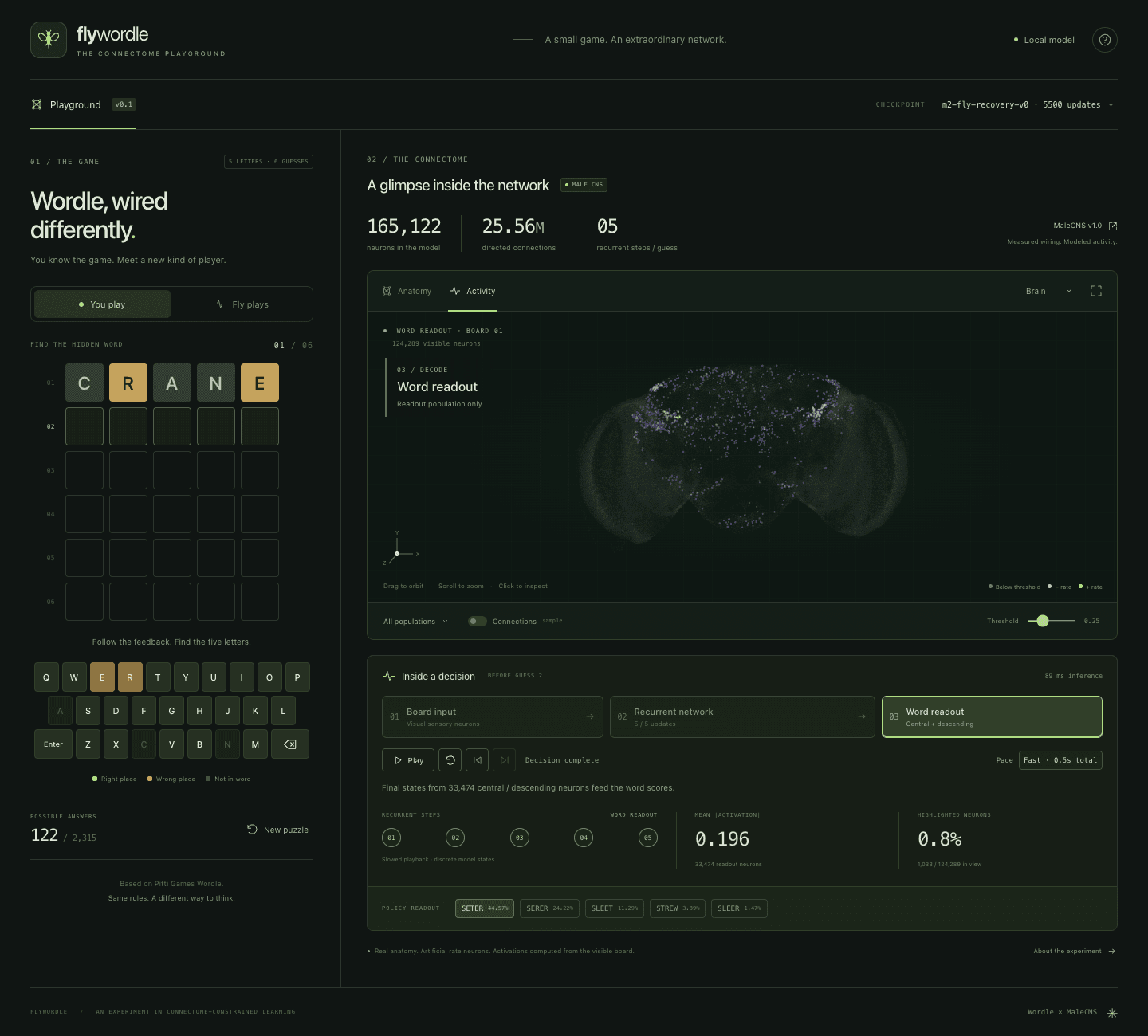
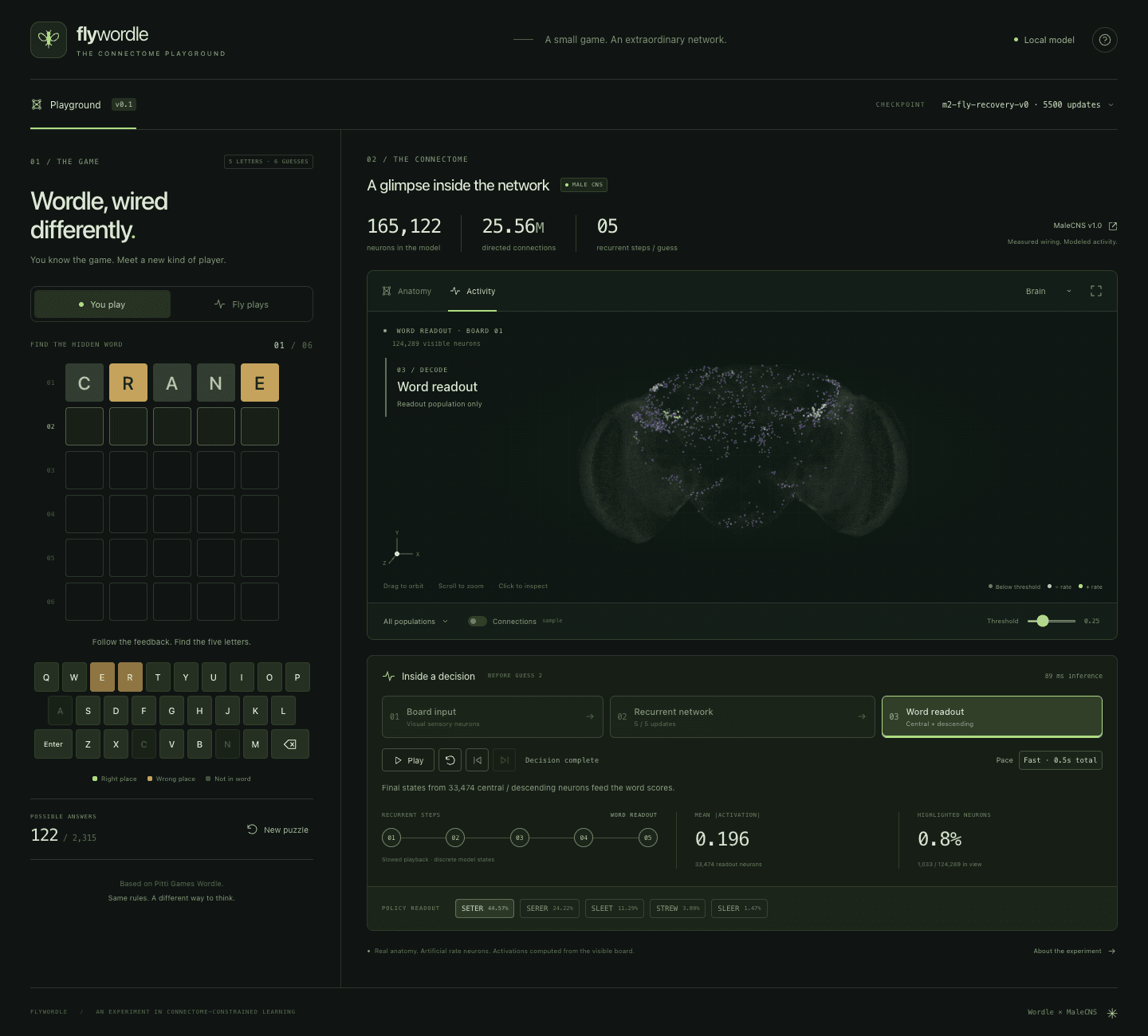
In September 2026, HHMI Janelia, Google Research and collaborators released a complete wiring diagram of a male fruit fly’s central nervous system. We used that connectome as the architecture for an AI model, then taught it to play Wordle.
The teacher was our entropy-based Wordle bot, which also powers Wordle Battles on PITTI Games. When we built it last year, we imagined using it to train small language models such as Qwen 0.6B. A fruit fly connectome was an unexpected next step.
From wiring to words
WordleFly uses 165,122 neurons and 25.6 million directed connections from the MaleCNS dataset. The board’s letters and colours enter through a learned input layer, activity passes through the network, and a readout ranks the possible guesses. The biological wiring supplies the structure of this artificial network; training learns how to use it for the game.
Our bot scores guesses by their expected information gain: how much they should narrow down the remaining answers. The model learns from these scores on both teacher examples and positions reached in its own games. At play time, it chooses from the visible board history.
Trained on a laptop
We trained WordleFly on a 2023 MacBook using Apple’s MLX framework. It was fun to watch the model change its opening word during training, eventually settling on ALERT. After 20,000 training steps, the model solved puzzles surprisingly well. That raised a question: had it simply memorised sequences of guesses from a fixed opening?
We tried supplying the first couple of guesses ourselves. The model always managed to take over and find the answer. An encouraging result, and a useful reason to explore its behaviour beyond games it starts on its own.
Watching it play
The browser interface pairs the Wordle board with an interactive 3D connectome viewer. You can play yourself, let the model play independently, or hand over a game you have already started. Each decision can be replayed from board input through the recurrent updates to the word readout, with the model’s activations displayed on the anatomical map.
Technical details: Python, MLX and custom sparse Metal kernels for training and inference; React, TypeScript and Three.js for the interface. Runs locally on Apple Silicon.
Coding assistant: Codex (GPT6 Astra, xhigh).
Development time: A handful of hours, excluding overnight training.